Showing posts with label Presidency. Show all posts

Tuesday, April 14, 2026

Confronting the Presidents

Bill O'Reilly and Martin Dugard proposed to examine the 45 men who have served as president and give a no spin assessment on each.  They failed utterly.  The book is 400 pages.  Do the math.  That is less than 10 pages per president and a lot of what is discussed is the daily routine of each.  What hours did they work?  What did they like for breakfast, lunch, and dinner?  What kind of exercise routine did they have, if any?  How'd they meet their wife?  These are so many thumbnail sketches that only scratch the surface of each man.  There is hardly any foundation to make an honest assessment.  The greatest failing is that the authors will condemn the actions of one president that they gloss over when done by another president.  Harding is pummeled for his adulterous affair while FDR and JFK are merely chastised.  The more recent the presidency, the more the authors' politics bleed into the assessment, more Dugard's than O'Reilly's.

The biography of each president is shallow, having to cover entirely too much in a short span.  Generally, the history is correct - maybe a wrong year listed here or the wrong name there - but the assessment follows the standard ratings that you would find among a typical poll of historians.

Though he clearly starts showing some personal opinions, I give O'Reilly credit for not going overboard.  That doesn't hold for his co-author.  The book was completed in 2024 and Dugard still held that Biden was up to a second term.  Seriously?  You call that no spin?  He even called 2020 the most contention election in US history while writing a book which included the 1860 election that led to Civil War!

This is a book for a novice.  It would have been better if the assessments had been left out and just let the reader judge.

Not recommended.

Thursday, January 1, 2026

Presidential Sons

Might it be the case that a lack of sons among most of the early presidents led to a more orderly transition of power?  Washington established the peaceful handoff, but the lack of sons may have aided in keeping the tradition going.

Founding Fathers

George Washington had no children of his own.  Martha had been widowed at age 26 and brought 2 children with her when she married Washington: John and Martha.  John became ill during the Siege of Yorktown (1781) and died shortly after the British surrendered.  Had Washington become a monarch, he had no progeny to benefit.

By contrast, John Adams had three son who survived to adulthood.  The eldest, John Quincy Adams, pursued a career in government and eventually became president during his father's lifetime.

Thomas Jefferson had only daughters.

Like Washington, James Madison had no children.  However, his wife, Dolley Payne Madison, had a child from her previous marriage.  John Payne impoverished his mother after James Madison died.

James Monroe's only son died in infancy.  Monroe is the last of the Founding Fathers to serve as president.

Antebellum Presidents

Almost 50 years after the Declaration of Independence, John Quincy Adams became the first to follow his father's footsteps into the White House.  Like his father, he had three sons.  Two died tragically and young (suicide and alcoholism), but Charles Francis Adams sought the Vice Presidency in 1848.

Andrew Jackson had no children, nor did his wife, Rachel, who had been previously married.  They adopted a nephew who proved to be a lot of trouble.

Martin Van Buren had two sons: Abraham and John.  Abraham served as personal secretary while his father was president.  John became the Attorney General of New York, an office his father had held.

William Henry Harrison had 10 children, but only 1 son outlived him.  Interestingly, that son, John Scott Harrison, was the father of President Benjamin Harrison.

John Tyler had the most children of any president, but he and his sons joined the Confederacy during the Civil War.

James Knox Polk had no children.

Zachary Taylor had one son, Richard, who went on to be a general in the Confederate Army.

Millard Filmore had one son, also named Millard, who a became a lawyer.

Franklin Pierce had 3 sons, all of whom died before he was inaugurated.

James Buchanan never married, earning his title as the bachelor president.

Abraham Lincoln had 4 sons, only 2 of whom survived him.  Of those, only Robert lived beyond the age of 18.  Robert became Secretary of War for President Garfield and Minister to the UK under Benjamin Harrison.

Post Civil War Presidents

Andrew Johnson had 3 sons, 2 of whom predeceased him and all of whom died of alcoholism.  Yikes.

Ulysses S Grant had three sons.  The eldest followed his father's footsteps by going to West Point and joining the military.  The younger two did pursue politics but without success.

Rutherford Hayes had 4 sons who survived him, none of whom pursued politics.

James Garfield had 3 surviving sons, one of whom went on to be Secretary of the Interior for President Theodore Roosevelt.

Chester Arthur had two sons, only one of whom made it to adulthood.  Chester Jr. proved to be a playboy, a man who lived a life of leisure.

Grover Cleveland had 2 sons by his wife.  As he married late in life, the boys were only 11 and 5 at the time of his death.

Benjamin Harrison's only son, Russell, became the US Consul for Mexico and Portugal.  Though he did become a politician, it was only at the state level in Indiana.

William McKinley had only two daughters, both of whom died by the age of 3.

20th Century Presidents

Theodore Roosevelt had four sons.  The youngest was shot down during WWI.  Two others died (heart attack & suicide) while in the military during WWII.  The last lived until 1979.  None followed their father into politics.

William Howard Taft had two sons.  Robert Taft became a noted Senator and sought the nomination for president several times but never won it.

Woodrow Wilson had only daughters.

Warren Harding had no children with his wife but did have a daughter by his mistress.

Calvin Coolidge had 2 sons, one of whom died during his presidency.  When Coolidge said that the business of government is business, his son, John, took it to heart and became a businessman.

Herbert Hoover had 2 sons, neither of whom pursued elective office.

FDR had several sons.  Two pursued elective office but never achieved anything close to their father's success.  The youngest son, John, did not seek office but he did become a Republican.  Yes, the youngest is usually the rebel.

Harry Truman had only one child, a daughter.

Dwight Eisenhower had two sons.  One died of scarlet fever at the age of three.  The other, John, followed his father example by joining the military but not politics.  John's son, David, would go on to marry Richard Nixon's daughter.

JFK had one son survive to adulthood.  JFK Jr. died in a plane crash when only 38.

LBJ had only daughters.

Richard Nixon had only daughters.

Gerald Ford had 3 sons, none of whom pursued politics.  Steven Ford is an actor.

Jimmy Carter had three sons. Jack Carter was the nominee for the Senate from Nevada but lost to the Republican.  The other sons have not pursued politics.

Ronald Reagan had two sons.  Michael was adopted with his first wife.  He followed his father into entertainment, notably talk radio.  I listened to his show a few times when I lived in Southern California.  Ron Jr. is his son with Nancy.  Ron is the rebellious son who became a Democrat.  Though he went into entertainment like his father, he didn't parley that into political office.

George Bush had four sons, two of whom became governors of major states (Texas and Florida).  George W Bush became the first son of a president since John Quincy Adams to become president.  JEB sought the Republican nomination in 2016.  George Bush himself was the son of Senator Prescott Bush.  Yes, here is the makings of a family dynasty to rival the Adams.  That's not a good thing, BTW.

Bill Clinton has only a daughter.

21st Century Presidents

George W Bush has only daughters.

Barack Obama has only daughters.

Donald Trump has three sons, 2 of whom followed their father into business.  Both Donald Jr. and Eric have also become activists since their father jumped into politics.  His third son, Barron, is still in college.

Joe Biden had two sons.  The older son, Beau, died while his father was Vice President.  The younger son, Hunter, has been one long source of scandal for his father.

One thing to note is how many of these presidential sons became alcoholics or drug abusers.  Several committed suicide.  It must be quite hard to live in the shadow of a presidential father.

Saturday, September 6, 2025

Return of the War Department

President Trump has signed an executive order renaming the Defense Department to the War Department.  For most of American history, it was the War Department.  In 1949, it was changed to the Defense Department, presumably to be less hostile sounding.  Of course, since the change, the US has generally lost wars.  Defense is a passive term.  You stand behind your castle wall and hold off the attackers.  That's defense.  By renaming the department, we linguistically dumped half of the mission: offense.  Is it mere coincidence that we've lost wars ever since?  Probably.

Pete Hegseth becomes the first Secretary of War since Kenneth Royall in 1947.  Three presidents have served as the War Secretary - James Monroe, Ulysses S. Grant, and William Howard Taft.  Let's see how things go with a War Department for a few decades and hope things improve.

Sunday, July 20, 2025

Van Buren vs. 4 Whigs

In 1824, Henry Clay was Speaker of the House and one of four Democratic Republicans running for president.  The others were Andrew Jackson, John Quincy Adams, and William Crawford.  Clay correctly predicted that no one would win the majority, which would throw the election of president to the House of Representatives.  As Speaker, he liked his odds of being selected there.  His plan was ruined when he placed 4th and the House could only consider the top three candidates.  Drats!

Twelve years later, Henry Clay's nascent Whig Party was pitted against Jackson's Vice President, Martin Van Buren.  The Whig Party was only a couple of years old and Clay - who had the best name recognition - chose not to run in 1836.  Instead, hearkening back the 1824, the Whigs fielded a slate of candidates, each running in states where they had the best chance at winning.  All they needed to do was prevent Van Buren from winning a majority of the electoral votes, which would let the House pick from the top contenders.

William Henry Harrison, who had largely vanished from politics more than a decade before, proved to be the most popular of the Whigs, winning 7 states and 37% of the popular vote.

Hugh White, a senator from Tennessee, won 2 states and 10% of the vote.

Daniel Webster, the famous orator and senator from Massachusetts, carried his home state and 3% of the vote.

Willie Mangum, yet another senator, carried South Carolina.  This was odd as he was the senator for North Carolina, which voted for Van Buren.

Despite the number of candidates arrayed against him, Martin Van Buren won a majority of the votes, nearly 51% and carried 15 states.

Though the gambit didn't pay off for the Whigs, they did discover which of their candidates they should run in the next election.  William Henry Harrison, Hero of the 1811 Battle of Tippecanoe and noted General from the War of 1812, had shown the most nationwide support.  It was thus no surprise when he was selected as the sole Whig candidate to face Van Buren in 1840.

Monday, January 6, 2025

Strange Duty of VP Presidential Candidates

Today, Vice President Kamala Harris certified the 2024 election in favor of her opponent, Donald Trump.  She is not the first vice president to have that uncomfortable duty.  Al Gore certified the 2000 election - in which he won the popular vote - for George W Bush.  Hubert Humphrey certified Richard Nixon's 1968 victory.  Nixon could sympathize with Humphrey, having been in the same position in 1960, when he certified his defeat against John F Kennedy.  One has to go back a century to find another sitting VP and failed presidential candidate announcing his opponent's victory.  John C Breckinridge was James Buchanan's VP.  He was one of 3 candidates opposing Lincoln and placed 2nd in the electoral college.  In February 1861, he announced that "Abraham Lincoln, of Illinois, having received a majority of the whole number of electoral votes, is elected President."  He then joined the Confederacy to oppose Lincoln in a less civilized fashion.

By contrast, only two VPs have had the joyous opportunity to preside over a victory.  VP George Bush certified his victory in the 1988 election.  Prior to him, one has to go back to Martin Van Buren who won the 1836 election as Andrew Jackson's VP.

The remaining two men who jumped directly from VP to presidency did so prior to the 12th Amendment.  As Washington's VP, John Adams was elected in 1796, but his opponent, Thomas Jefferson, won the vice-presidency.  The awkwardness of having the president and VP from rival parties brought about the 12th Amendment so that - generally - each party put up their picks for each office.  Thus, in 1800, Adams and Jefferson had a rematch but selected VP candidates; Aaron Burr for Jefferson and Charles Cotesworth Pinckney for Adams.  The Jefferson-Burr ticket won, but both had identical electoral vote totals.  Now Burr argued that he had just as much right to be president as Jefferson.  This triggered a contingent election where the House had to choose, thus denying Jefferson the opportunity to announce his victory.

Sunday, December 29, 2024

Post Presidency Statistics

A previous blog discussed the number of former presidents upon whom the current president could call.  With the passing of President Carter, the number of former presidents has gone down from 5 to 4.  Strangely, it will remain 4 after the inauguration as Donald Trump will leave the ex-presidents and Joe Biden will join them.  How long does a post-presidency generally last?  That depends on how you look at it.

The median post-presidency lasts for 8.26 years.  That is, there are as many presidents above that number as below.  22 Presidents had shorter post-presidencies and 22 had longer.

The average post-presidency is 11.32 years.  Having lived as a former president for nearly 44 years, Jimmy Carter pulled that average up.

The mode - which is the most frequent result - for a post-presidency is 0 years.  Yes, 8 presidents died in office and thus never became former presidents.

The post-presidency is getting longer.  Every former president since Nixon has live at least 15 years after leaving office.

President Carter

Only 2 months after his 100th birthday, President Carter has died.  Of all presidents, he had the longest post-presidency by far.  He was an ex-president for 43.9 years.  His nearest competitor, Herbert Hoover, lived to the age of 90, having been ex-president for 31.6 years.  His record cannot be beaten for at least another 20 years.  If Bill Clinton makes it to 98, he could outdo Carter.  George W Bush would have to make it to 106, which seems unlikely.  Next, Barack could surpass Carter in 36 years, at age 99.  Trump and Biden aren't in the running unless something really amazing happens in longevity research.

In many ways, Carter was an unusual president.  As mentioned in a recent blog, he never chose a justice for the Supreme Court.  His predecessors did not burden him with an ongoing military conflict, and he didn't start any during his term.  Yes, Iran and Afghanistan became major issues, but the US didn't go to war.  Carter tried to resolve foreign conflicts with peace talks and boycotts rather than tanks and soldiers.  Commendable, but of questionable effect.  He is one of four presidents to win the Nobel Peace Prize.

Jimmy Carter was the first president I recall.  When I was in the 4th grade, a TV was rolled into the classroom and we watched the inauguration.  One is not usually politically aware at that age, but it was from that point that I could always answer the question: Who is the president of the United States?

RIP

Sunday, December 22, 2024

Nobel Peace Prize Presidents

The Nobel Peace Prize was first awarded in 1901.  It was to be given "to the person who shall have done the most or the best work for fraternity between nations, for the abolition or reduction of standing armies and for the holding and promotion of peace congresses."  Since then, 4 American Presidents have won the Nobel Peace Prize.

Theodore Roosevelt (1906): The president who called for speaking softly and carrying a big stick held a peace conference to end the Russo-Japanese War (1904-1905).  Despite his jingoist reputation - or more likely because of it, Roosevelt had no wars during his presidency and managed to quell one in which the US was not a participant.  He is the only Republican president to win the Nobel Peace Prize.

Woodrow Wilson (1919): The president who "kept us out of the war" until he was safely re-elected won the peace prize for his role in founding the League of Nations.  Though he had been its leading proponent, he was unable to convince the US Senate to ratify membership.  Thus, the US didn't join.  The US did join the League's successor, the United Nations.  Secretary of State Cordell Hull won the 1945 Peace Prize for that.

Jimmy Carter (2002): Though he won it long after his presidency ended, his peace prize recognized his years of work as a peacemaker.  Of particular note, the Camp David Accords, which led to a peace deal between Israel and Egypt, were hosted by President Carter during his presidency, very like the peace conference Roosevelt had hosted in 1905.  The 1978 Peace Prize was awarded to Menachem Begin of Israel and Anwar Sadat of Egypt.  The oversight of Carter's role was rectified in 2002.

Barack Obama (2009): President Obama was awarded the peace prize only 9 months into his administration "for his extraordinary efforts to strengthen international diplomacy and cooperation between peoples."  Whereas the other three presidents had clear accomplishments in pursuit of peace, Obama had only aspirational speeches. At the time, this looked to be an award for things to come. Even Obama himself was astonished and suggested that it was not "a recognition of my own accomplishments but rather an affirmation of American leadership on behalf of aspirations held by people in all nations."

In recent decades, the Nobel Peace Prize has been awarded arbitrarily.  The parameters for the award are clear: 

to the person who shall have done the most or the best work for fraternity between nations, for the abolition or reduction of standing armies and for the holding and promotion of peace congresses.

This is an award for diplomats, disarmament proponents, and peaceniks.  Former VP Al Gore won in 2007 for his film about climate change.  The 2011 peace prize was awarded to those struggling for women's rights in Liberia and Yemen.  The 2014 peace prize recognized efforts to educate young people in India and Pakistan.  Yes, these are laudable goals, but do they best represent the stated intent of the award.  I don't think so.

Sunday, December 15, 2024

Pardon Me

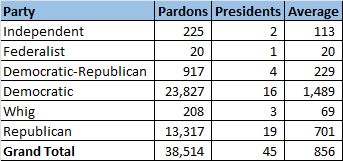
The power to pardon has been in the Constitution from the beginning.  George Washington issued 16 pardons during his 2 terms in office.  Only William Henry Harrison and James Garfield issued fewer pardons.  In fact, they each issued none on account of dying early in their presidencies.  John Adams, the sole Federalist president, only issued 20.  The power of the pardon has grown since then.  Let's see how that breaks down by party.


Independent

Washington didn't like the party system though he most aligned with the Federalist Party.  However, he spoke against parties so he's generally classified as Independent.  He offered 16 pardons.  John Tyler, the 10th President, was originally a Democrat but switched to Whig.  When he took over for William Henry Harrison, the Whigs disowned him and the Democrats didn't want him.  Thus, he falls into the Independent Party.  He offered 209 pardons.  Tyler lifted the average per president quite a bit.

Federalist

There was only 1 Federalist, President John Adams.  Following Washington, he was stingy with the pardons, only granting 20 in his 4 years as president.

Democratic-Republican

The Party of Thomas Jefferson, it primarily competed with the Federalist until they disintegrated after the War of 1812.  Jefferson, Madison, Monroe, and John Quincy Adams were Democratic-Republicans.  The party was much more generous with pardons, offering 917.

Democratic

Having lost the 1824 election, Andrew Jackson split from the Democratic-Republicans to create a new party.  This is the Democratic Party that continues to this day.  It is the most generous with pardons, averaging 1,489 per president.  This number does not include Andrew Johnson's blanket pardon for many Confederates after the Civil War or Jimmy Carter's blanket pardon to over 200,000 draft dodgers after Vietnam.  Franklin Pierce was the stingiest with pardons (142), while Joe Biden has more than doubled 2nd place FDR (3,687) with 8,027 pardons so far.

Of particular note, Joe Biden has dramatically lifted the average.  Removing Joe Biden's 8,027 pardons, drops the Democratic average to 1,053 per Democratic president.  How high will it go by January 20th?


This reminds me of Al Gore's hockey stick graph.

Whig

There were only 3 Whig Presidents and two of them died early in their presidencies.  The Whigs only issued 208 pardons.

Republican

The Party of Lincoln has had more presidents than its nearest rival, the Democrats.  A Republican president averages 701 pardons.  Calvin Coolidge offered the most pardons (1,545) of any Republican while George HW Bush offered the fewest (77), if we excluded James Garfield, who issued none before his assassination.

From Eisenhower to Trump (1953 to 2021), there were 8,126 pardons.  President Biden is going for the Guinness Book of World Records.

Saturday, December 14, 2024

Truncated Presidential Terms

A full term for a US President is 4 years, which is 1,461 days.  Most presidents who did not reach the 1,461 days died in office, resigned, or had been elevated from the vice presidency to fill a vacancy.  However, there are four exceptions, presidents who served a full term and yet it was less than 1,461 days.  How does that work?

George Washington wasn't inaugurated until April 30, 1789.  As the new government was just getting started, Washington wasn't elected until April 6th.  He didn't leave Mt. Vernon until April 16 and was inaugurated upon arriving in New York City.  His first full term was 1,404 days.

John Adams served from March 4, 1797 to March 4, 1801.  Thanks to the absence of a leap day in 1800, his time in office was only 1,460 days.  Leap days don't occur in years divisible by 100 unless it is divisible by 400.  Thus, 2000 had a leap day for Bill Clinton's second term, but 1800 didn't for John Adams.

William McKinley's first term started on March 4, 1897 and ended on March 4, 1901.  Just like Adams, his term was missing a leap day in 1900.  Unlike Adams, he was reelected.  He was assassinated 6 months into his second term.

Franklin Delano Roosevelt served for 3 full terms and began a 4th when he died.  The 20th Amendment had been ratified shortly before his inauguration in 1933.  The amendment changed inauguration day from March 4 to January 20.  FDR's first term began on March 4, 1933, but ended on January 20, 1937.  This proved to be only 1,418 days.

Of note, both John Tyler (1841-1845) and Andrew Johnson (1865-1869) had longer partial terms than either Washington or Roosevelt's full terms.  Tyler took over after William Henry Harrison died only 1 month into office.  That left 1,430 days for Tyler's partial term.  Johnson became president after Lincoln's assassination and served 1,419 days.

Sunday, December 8, 2024

Presidents and the Supreme Court

Which president selected the most Supreme Court justices?  It should come as no surprise that President Washington, being the first President, had the opportunity to select every justice on the original court.  However, he only just surpassed another president.  Let's see which presidents had the most judicial picks and those with the fewest.

There have been 116 justices, 17 of whom were Chief Justices.  It is worth noting that the Court began with only 6 justices, before expanding to 7, 9, 10, and then shrinking to the current 9.

Four presidents did not select any justices.  William Henry Harrison (9) died only 1 month into office.  Zachary Taylor (12) died 16 months into office.  The Congress changed the law in order to prevent Andrew Johnson (17) from having an opportunity to select a justice.  Of note, the Court had 10 justices at the time and was slated to shrink to 7.  With Johnson's departure, the Court was restored to 9 justices.  Lastly, Jimmy Carter (39) didn't get to select a justice.

James Monroe (5), John Quincy Adams (6), John Tyler (10), Millard Fillmore (13), Franklin Pierce (14), James Buchanan (15), James Garfield (20), William McKinley (25), Calvin Coolidge (30), Gerald Ford (38), and Joe Biden (46) each selected one justice for the Court.

James Madison (4), Martin Van Buren (8), James K Polk (11), Rutherford B Hayes (19), Chester Arthur (21), JFK (35), LBJ (36), George HW Bush (41), Bill Clinton (42), George W Bush (43), and Barack Obama (44) each selected 2 new justices to the Court.  However, George W Bush had the opportunity to select the 17th Chief Justice, John Roberts.

John Adams (2), Thomas Jefferson (3), Theodore Roosevelt (26), Woodrow Wilson (28), Herbert Hoover (31), and Donald Trump (45) selected three each.  John Adams chose the longest-serving Chief Justice, John Marshall.  Of note, Marshall was the 4th Chief Justice despite being chosen by only the 2nd president.  Hoover selected Charles Evans Hughes for Chief Justice; Hughes had been an associate justice and was Chief Justice William Howard Taft's chosen successor.

Ulysses Grant (18), Grover Cleveland (22 & 24), Benjamin Harrison (23), Warren Harding (29), Harry Truman (33), Richard Nixon (37), and Ronald Regan (40) selected 4 justices for the Court.  Most of these presidents also selected a new Chief Justice among the four picks.  Grant chose Marrison Waite, Cleveland selected Melville Fuller, Harding installed former President William Howard Taft, Truman picked Fred Vinson, Nixon chose Warren Burger, and Reagan elevated William Rehnquist (Rehnquist had been one of Nixon's Associate Justice picks).

Abraham Lincoln (16) and Dwight Eisenhower (34) each had 5 Court picks.  Lincoln chose Salmon Chase as the Chief Justice.  Eisenhower selected Earl Warren to be Chief Justice.

Andrew Jackson (7) and William Howard Taft (27) selected 6 justices for the Court.  Jackson replaced John Marshall with Roger Taney, the Chief Justice who is forever stained with the Dredd Scott decision.  Taft, who would later be appointed Chief Justice, elevated Edward D White to be Chief Justice.  He would replace White only a decade later.

Franklin Delano Roosevelt (32) chose 9 justices during his three terms as president.  He elevated Harlan F Stone, an associate justice, to be the Chief Justice.

George Washington (1) selected 10 justices for the Court.  Though there were only 6 justices at the time, the turnover was higher.  In these early days, the Court didn't possess the prestige or power that it would gain in later years.  For the first Chief Justice, he chose John Jay.  Jay stayed in the position for 5 years before resigning to run for governor of New York (he won).  Washington next chose John Rutledge.  Rutledge had been rejected for associate justice by the Senate in 1789 and, when the Senate was again in session, he was rejected for Chief Justice as well.  He served about 5 months as Chief Justice.  Thus, Washington chose the 3rd Chief Justice, Oliver Ellsworth.

Monday, November 25, 2024

When the States Joined

One accomplishment that is usually listed under the record of a president is the states that were added during his term.  The last state added, Hawaii, was during the Eisenhower Administration.  Which president oversaw the most states added to the Union?  Surely, Washington would be the obvious guess.  But that would be incorrect!  Let's have a look from the least to the most.

ZERO STATES

John Adams, John Quincy Adams, Martin Van Buren, William Henry Harrison, Zachary Taylor, Franklin Pierce, Rutherford Hayes, James Garfield, Chester Arthur, William McKinley, Woodrow Wilson, Warren G Harding, Calvin Coolidge, Herbert Hoover, FDR, and Harry Truman added no states during their tenure.  Of course, anyone after Eisenhower is clearly in the zero states camp as well.  That would be JFK, LBJ, Richard Nixon, Gerald Ford, Jimmy Carter, Ronald Reagan, George Bush, Bill Clinton, George W Bush, Barack Obama, Donald Trump, and Joe Biden.  

ONE STATE

- Thomas Jefferson added Ohio, the 17th State, in 1803.

- John Tyler added Florida, the 27th State, on March 3, 1845.  He left the Presidency the following day.

- Millard Fillmore added California, the 31st State, in 1850.

- Andrew Johnson added Nebraska, the 37th State, in 1867.

- Ulysses Grant added Colorado, the 38th State, 1876.

- Grover Cleveland added Utah, the 45th State, in 1896.  This happened in his second term, which is noteworthy because it was not consecutive with his first.

- Theodore Roosevelt added Oklahoma, the 46th State in 1907.

TWO STATES

- James Madison added Louisiana (18th) in 1812 and Indiana (19th) in 1816.

- Andrew Jackson added Arkansas (25th) in 1836 and Michigan (26th) in 1837.

- Abraham Lincoln added West Virginia (35th) in 1863 and Nevada (36th) in 1864.  It is noteworthy that West Virginia had been part of Virginia and chose to breakaway as a new state to join the Union.  Of course, Lincoln also lost a number of states but that's a topic for another blog.

- William Howard Taft added New Mexico (47th) and Arizona (48th), both in 1912.

- Dwight Eisenhower added Alaska (49th) and Hawaii (50th) in 1959.

THREE STATES

- James K Polk added Texas (28th) in 1845, Iowa (29th) in 1846, and Wisconsin (30th) in 1848.

- James Buchanan added Minnesota (32nd) in 1858, Oregon (33rd) in 1859, and Kansas (34th) in 1861.  Interestingly, he added Kansas after South Carolina, Mississippi, Florida, Alabama, Georgia, and Louisiana had already seceded.

FIVE STATES

- George Washington added North Carlonia (12th) in 1789, Rhode Island (13th) in 1790, Vermont (14th) in 1791, Kentucky (15th) in 1792, and Tennessee (16th) in 1796.  The first eleven states - Delaware (1), Pennsylvania (2), New Jersey (3), Georgia (4), Connecticut (5), Massachusetts (6), Maryland (7), South Carolina (8), New Hampshire (9), Virginia (10), and New York (11) - had already been recognized as part of the country by ratifying the Constitution.  This happened before Washington was president.

- James Monroe added Mississippi (20th) in 1817, Illinois (21st) in 1818, Alabama (22nd) in 1819, Maine (23rd) in 1820, and Missouri (24th) in 1821.

SIX STATES

- Benjamin Harrison added North Dakota (39th), South Dakota (40th), Montana (41st), and Washington (42nd), all in the first two weeks of November in 1889.  Idaho (43rd) and Wyoming (44th) were added in July of 1890.  In a little more than 8 months, Harrison added 6 states.  It is also noteworthy that the US Census of 1890, which took place during Harrison's only term, declared an end to the American Frontier; the West was settled.

Tuesday, October 1, 2024

Presidential Centenarian

Jimmy Carter, 39th President of the United States, achieved the age of 100 today.  When you consider that all his siblings and his father died of pancreatic cancer, this is nothing short of a miracle.  His father died at 58, his sisters at 63 and 54, and his brother at 51.  Did the deadly gene that cursed his father and siblings miss him or has he lived his life in such a way to dodge pancreatic cancer?  I wonder if any medical researchers have thought to look into this?  Maybe Carter stumbled on a cure or preventative measure.

Happy Birthday, Mr. President!

Monday, September 16, 2024

Presidential Rankings - The Dead Ones

Three presidents did not serve long enough in office to merit ranking.  However, just to make sure that every president is listed, here are the rest:

William Henry Harrison: The oldest man elected president until he was surpassed by Ronald Reagan, Harrison was the first Whig President.  He died after only a month in office - the first president to die in office - and was replaced by Vice President John Tyler.  Virtually all of Harrison's cabinet secretaries resigned within six months of his death, erasing what little imprint he had left on Tyler's Administration.  How do you rank someone who served 1 month?

Zachary Taylor: The second Whig President, Taylor lasted longer than Harrison.  He died during the debate over the Compromise of 1850, the most significant legislation of the time.  Had he survived to shape it (he had different ideas than his VP, Millard Filmore), ranking him would make sense.  His was the longest presidency of the three at 16 months.

James Garfield: A Civil War veteran and long-serving Congressman, Garfield was assassinated by a frustrated job seeker.  He lingered for two months before dying from his wound.  He had been president for 4 months when he was shot and 6 months when he died.

All three were generals.  William Henry Harrison led troops during the War of 1812, though his most famous battle was that of Tippecanoe in 1811.  Zachary Taylor was a leading general during the Mexican American War, winning such plaudits that he was pursued to run for president.  James Garfield was an officer in the Ohio Volunteers who rose to Major General during the Civil War.

Graboyes didn't offer any details on them as they were excluded from his rankings.

Presidential Rankings - The Terrible Ones

These are the presidential disasters, highly-negative leaders who clearly damaged the well-being of the nation.

Franklin Pierce: An unknown politician unprepared for the presidency.  His last surviving child died shortly before Pierce assumed the presidency, sending him into alcohol and grief.  He pandered to slave owners and vilified abolitionists.  The Gadsden Purchase took place during his presidency.

James Buchanan: Most impressive resume prior to George H W Bush, but twiddled his thumbs as the country descended into Civil War.  Did nothing as the South seceded after the election but before Lincoln's inauguration.

Andrew Johnson: Lincoln's greatest mistake.  A pro-slavery demagogue who was entirely unsuited to the task of healing a nation in the aftermath of the Civil War.

Woodrow Wilson: Worst racist in presidential history.  Reversed racial progress rather than accept the status quo.  Set the stage for the rise of the Nazis and WWII.  Imprisoned political opponents, notably Eugene Debs.  Held constitutional limits in low regard, ignored civil liberties, refused to negotiate with Senate Republicans in foreign policy (which killed his League of Nations), and hid his debilitating stroke for more than a year at the end of his term.

Herbert Hoover: Tragic figure.  Brilliant, accomplished, and well-meaning.  However, he was a compulsive busybody whose efforts to fix the economy only worsened the Great Depression.  Began many of the New Deal policies that FDR adopted; they were all bad.

Jimmy Carter: Economic incompetence, foreign affairs disasters, angering allies and fawning over enemies.  Responsible for the rise of the Iranian mullahs.  Emboldened Islamic terrorists for decades thereafter by showing such astonishing weakness.  The malaise speech, the misery index, inability to get along with Congressional Democrats, let alone the Republicans.  Acted to undermine virtually every successor, regardless of party.

Yes, I can agree with this bunch.  Franklin Pierce wasn't even considered as the candidate until the 35th ballot.  The big guns - Lewis Cass, James Buchanan, Stephen Douglas, and William Marcy - could not assemble two-thirds of the delegates to capture the nomination.  Pierce was a dark horse who was enough of a blank slate that he won the nomination on the 49th ballot.  Is it any wonder he was not ready for the job.  The Democrats saw their error from 1852 and did not renominate Pierce in 1856, instead choosing Buchanan.  Despite a tremendous resume, he too failed miserably.  Like George H W Bush, Buchanan was groomed for a foreign policy presidency and was unsuited to domestic issues.  Andrew Johnson was a Tennessean who favored the Union.  Straddling both sides, one would think he would be ideal in the wake of the war.  Instead, he paved the way for Jim Crow rather than racial equality.  Wilson did not like the Constitution or the Republic it established.  He was indeed a horrible president.  Hoover had been part of the Harding Administration when Secretary of Treasury Andrew Mellon deftly turned Wilson's post-war depression into nearly a decade of prosperity.  Instead of trying to duplicate that, he tinkered and meddled, transforming a downturn into the Great Depression.  I would guess that Graboyes had first-hand experience with the Carter presidency based on the laundry list of failings.  I've always viewed Carter in much the way he paints Hoover: a well-meaning man who inadvertently did far more harm than good.

Responding to a comment regarding his rankings, Graboyes said that the six terribles led to hell: Pierce & Buchanan to the Civil War, Johnson to Jim Crow, Wilson to Nazism, Hoover to Depression, and Carter to Jihadism.  He also speculates that it might have been better to have 7 tiers rather than 5.

Sunday, September 15, 2024

Presidential Rankings - The Bad Ones

To fall under the 'somewhat negative' category, Graboyes states that the president "governed badly, had serious personal failings, or both."

John Quincy Adams: A great man who rose to his highest level of incompetence.

Martin Van Buren: A fixer who was not suited to the top role.  Helpless against the Panic of 1837 that was the hangover of the Jackson years.

Lyndon Banes Johnson: One of the most skilled and competent presidents ever but his policies have left lasting damage, notably Medicare and Medicaid.  No personal ethics.  His handling of Vietnam.

Richard Nixon: Competent and skilled, he resolved LBJ's Vietnam disaster and established relations with China.  However, he embraced bad economic policies (price controls) and destroyed his presidency by his actions regarding Watergate.

Gerald Ford: Creditable job of post-Watergate leadership.  Bad foreign policy and economic policies.

Bill Clinton: Though he had the makings of a somewhat positive president with his political skills, moderated views, charming demeanor, and strong intellect, he poisoned it with his sexual scandals, financial shenanigans, perjury, and unpardonable pardons.

Barack Obama: Ended NASA monopoly on space which allowed SpaceX to flourish, took out bin Laden.  His embrace of racial division, frequent attacks on his predecessor, and beneficial treatment of Iran were harmful.  He created a cult of personality that his party has yet to overcome.

Donald Trump: Despite a long list of impressive accomplishments (Abraham Accords, Jerusalem embassy, smashing ISIS, energy independence, end of the Iran Deal, the COVID vaccine, roaring economy, low unemployment - notably for blacks and Hispanics, border enforcement, Space Force, and Judicial appointments), Trump more than offset it with his verbal diarrhea and J6 catastrophe.

Joe Biden: He reversed most of the positives of the Trump administration.  The end of energy independence once again filled the coffers of adversaries: Russia & Iran. Iran financed Hamas (October 7 attack in Israel and the latest Gaza War), Hezbollah, and the Houthis (Red Sea conflict).  Inflation.  Open border, mobs at homes of the Supreme Court, obvious signs of dementia.

Mostly, I'll agree.  He's a bit hard on Martin Van Buren.  He had some foreign policy successes that determined the borders of the United States and Canada, but that Panic of 1837 really sank him.  The Amistad was just a footnote.  Nixon established the imperial presidency, seeking to create executive positions that duplicated the Cabinet in order to expand those protected by executive privilege.  Given how many positives he lists for Trump, the negatives must really weigh a lot in his estimation.

Presidential Rankings - The So-So Ones

The tier three presidents - rating as 'neutral' - were those who had mixed legacies.

John Tyler: He established that the VP would become the full-fledged president in the event of a president's death.  He vetoed Henry Clay's economic plan and negotiated the annexation of Texas.  However, he died during the Civil War as a member of the Confederacy.

Millard Filmore: He approved the Compromise of 1850 and opened trade with Japan.  He later sullied his reputation by running as a Know-Nothing.

Rutherford Hayes: He ended Reconstruction, peacefully addressed violent labor, fought inflation, and installed the first telephone in the White House.

Grover Cleveland: Resisted the populist impulses of the Bryan era, wanted a strong dollar, but plagued by labor riots and the Panic of 1893.

Benjamin Harrison: Improved foreign relations in the Western Hemisphere and pushed out political hacks for competent personnel.

William Howard Taft: A humdrum presidency between two egomaniacs.  The most distinguished ex-president by serving as the Chief Justice of the Supreme Court.

John F Kennedy: He had the most inspiring rhetoric, set the US on a path to the moon, and turned the Soviets back from Cuba.

George Bush: Significant president who had successes and failures.  Did not partake in the post-presidency criticism of predecessors or successors.

George W. Bush: Also a significant president who had successes and failures.  Did not partake in the post-presidency criticism of predecessors or successors.

Tyler missed out on a higher ranking because of his post-presidency.  It wasn't until the 25th Amendment that his action of assuming the presidency was codified.  He gamed the 1844 election to assure the annexation of Texas.  Filmore may have sent Perry to Japan, but he was out of office by the time Perry returned.  By approving the Compromise of 1850, the Civil War was almost certainly averted for another 10 years that improved the North's chances of winning.  Hayes didn't exactly agree with the end of Reconstruction.  Sam Tilden - the Democrat - won the popular vote and the electoral vote was questionable.  There was a lot of fraud and disenfranchisement of blacks.  In order to assure Hayes as president, Reconstruction was put on the chopping block.  I wouldn't give Hayes credit for that.  Cleveland was a northern Democrat who wasn't so keen on civil rights.  However, he was vastly better than the next Democrat president would be.  Harrison and Taft are suited to the neutral tier.  JFK did give some of the best speeches.  Though outwardly it looked like the US won the Cuban Missile Crisis, it has since been shown to be a draw; Russia got a quid pro quo.  George Bush was trained to be a foreign policy president, to continue the Cold War, and then it ended a year into his presidency!  He was not meant to be a domestic president, somewhere he did not excel.  Despite George W Bush getting re-elected where his father didn't, I'd rate his father as the better president.  However, middle of the pack suits both father and son.

Presidential Rankings - The Good Ones

According to Graboyes, the Somewhat Positive presidents made positive but not earth-shattering contributions.

John Adams: A great man but mediocre president.

James Madison: Another great man who proved to be a mediocre president.

Andrew Jackson: He changed American politics and governance.  He stamped out nullification.  He might have rated among the greats but for his treatment toward Native Americans.

Ulysses Grant: He criminalized the KKK, reversed course from Jackson regarding Native Americans, and sought to stabilize the dollar.  However, his administration was plagued by corruption, which stained him though he supported investigations.

Chester Arthur: Elevated to the presidency in the wake of James Garfield's assassination, Arthur reformed the Civil Service.  Here was a man who had benefited from the existing system and knew what needed to be reformed.  He also strengthened the navy and sought to improve the lot of former slaves and Native Americans.

William McKinley: Though he wanted peace with Spain, he went to war when his efforts failed.  He also strengthened Anglo-American ties.

Warren Harding: Ended the disaster that was the Wilson years - releasing some political prisoners - and began an era of prosperity.  He appointed former President Taft to the Supreme Court and his choice of Andrew Mellon for Treasury was particularly good.  He had good bipartisan relations.  However, he died in office and was stained by stories of his adultery and the Teapot Dome Scandal.

Calvin Coolidge: Harding's vice president, Coolidge was a limited government adherent, resisting efforts of the federal government to infringe on the states.  He advocated individual rights and ran a clean administration.  Ronald Reagan viewed Coolidge very highly.

Dwight Eisenhower: Ike ended the Korean War, didn't get the US entangled in Vietnam, founded the Interstate Highway System and the US Space Program.  Also, he sent troops to Little Rock to enforce desegregation.

This list comes as a bit of a surprise.  John Adams had the Alien and Sedition Acts, which infringed on the First Amendment.  That's a big negative.  He won the Quasi-War with France and was the first president to live in the White House.  Yeah, he only ranks in the somewhat positive as a lifetime achievement award.  Likewise, James Madison's presidency was mostly the War of 1812, which was mostly a disaster.  The White House was set on fire by the British.  If not for Andrew Jackson's success at New Orleans and the amazing performance of the US Navy, Madison would look much worse.  Again, his rating among the good seems like a lifetime achievement award.  I completely agree with his rating of Jackson.  Massively consequential president but also an ass.  The Democrats use the Jackass as their symbol on account of Jackson.  Like Monroe after the War of 1812, Grant had a postwar presidency though it wasn't another Era of Good Feelings.  Though he enforced Reconstruction, there were a lot of Indian Wars in the West during his presidency.  Yes, he wasn't as anti-Indian as Jackson, but he was hardly in their corner.  He might be getting the bump to somewhat positive on account of winning the Civil War.  It starts to look as though the quintile division scheme is forcing some so-so presidents upwards.  McKinley oversaw the expansion of the US into an empire.  The Spanish American War brought the Philippines and Puerto Rico as US possessions.  There was also the annexation of Hawaii.  McKinley was ambivalent about the war; Theodore Roosevelt - who was assistant secretary of the navy at the time, accused him of having the backbone of a chocolate eclair.  Harding is often ranked much lower, but his placement here is fair.  The return to Normalcy is underrated.  Coolidge and Eisenhower definitely rank toward the top of this batch.

Presidential Rankings - The Great Ones

I have long disagreed with the regular presidential rankings that are published every few years.  Invariably, the most recent Republicans are at the very bottom and the most recent Democrats rank very highly.  No bias there.  A couple of weeks ago, I came across one by Robert Graboyes that did not follow the usual rankings.  The presidents are separated into quintiles: highly positive, somewhat positive, neutral, somewhat negative, and highly negative.  There is a 6th category for those who died so early in office that they don't merit ranking.  Let's start with the greats (i.e., highly positive):

Graboyes defines highly positive as leaving "at least one blockbuster accomplishment that swamps any negatives."

George Washington:  He was the first president and established what the office would be.  Everything he did became a precedent, including his resignation after 2 terms.  He defined the presidency.

Thomas Jefferson: The third president bought Louisianna from Napoleon, dramatically expanding the United States.  Where most nations were paying protection to the Tripolitan pirates, Jefferson sent the Marines.

James Monroe: Other than Washington, Monroe is the only president to run unopposed for re-election.  His time in office was known as the Era of Good Feelings.  He announced the Monroe Doctrine, which declared the Western Hemisphere as off-limits to European powers.

James Knox Polk: Nearly doubled the size of the United States and established treasury autonomy.  As a longtime Polk fan, it pleases me greatly that he was placed in the highly positive group.  This surely impacts my view of his overall picks.

Abraham Lincoln:  He saved the Union.  Enough said.

Theodore Roosevelt: He strengthened the presidency and established America as a superpower.  Indeed, he is the first US president to win the Nobel Peace Prize.

Franklin Delano Roosevelt: He led the allies to victory.

Harry Truman: He began the containment of Communism.

Ronald Reagan: He turned the economy around from the Ford/Carter mess, starting a 25-year economic boom.  More importantly, his strategy ended the Soviets without a war.

Generally, this is a good list.  I will quibble about FDR, whose actions regarding the Great Depression and threats of packing the Supreme Court should cost him a great spot.  However, FDR has been listed as one of the three greats - with Washington and Lincoln - in almost every list.  If Mount Rushmore had been carved in the 50s or later rather than the 20s and 30s, FDR would be on it.

Tuesday, August 27, 2024

Three Time Loser: The Corrupt Bargain!

Henry Clay was born in Virginia in 1777.  Twenty years later, he moved to Kentucky and began a law practice.  He was involved in politics from the start, having suggested revisions to the Kentucky Constitution to gradually end slavery (1799), being elected to the Kentucky House of Representatives (1803), to serving as a US Senator (1806-07, 1810-11).  He didn't much care for the Senate and pursued a career in the House of Representatives.  Despite being a freshman Congressman, Clay was elected to be Speaker of the House; he was only 34 years old.  He proved to be a commanding speaker and led the war hawks in demanding war with Britain.  Indeed, the Congress - as is its prerogative - declared war on June 18, 1812.  Two years later, Clay was selected by President Madison to join the peace commission in the Netherlands to end the war.  Also on the commission was John Quincy Adams, son of President John Adams.

In 1824, James Monroe followed the example set by Washington, Jefferson, and Madison to retire after 2 terms in office.  The Federalist Party had evaporated, which led to 4 Democratic-Republicans competing for the presidency.  There was General Andrew Jackson, Secretary of State John Quincy Adams, Secretary of the Treasury William Crawford, and Speaker of the House Henry Clay.  With so many candidates, Clay was certain that no one would gain enough electoral votes to win; that would send the election to the House of Representatives.  He was certain that he would be chosen in the body he led.  Though it was a sound plan, Clay placed fourth and the 12th Amendment only allowed the House to select among the top three.  Foiled!  It was his first losing run for the presidency.

Though he could not win, he had the power to select among the three.  William Crawford had suffered a stroke and was unsuited to the presidency at this point.  There was bad blood between Clay and Jackson.  In 1818, Jackson had invaded Spanish Florida and hanged two British subjects.  Clay found this outrageous and accused him of being a potential military dictator, like Bonaparte, Cromwell, Caesar, or Alexander the Great.  Though Jackson had the largest vote total of the three candidates, Clay would not lobby in favor of him.  That left his former peace commission colleague, John Quincy Adams.

John Quincy Adams was chosen by the House as the next president.  It is noteworthy that Adams had been serving as President Monroe's Secretary of State.  Each of his three predecessors - Monroe, Madison, and Jefferson - had served as Secretary of State.  It was a training ground for future presidents.  President Adams selected Henry Clay to be his Secretary of State.

If there had been bad blood between Clay and Jackson before, this greatly exacerbated the feud.  Jackson declared a 'Corrupt Bargain' had been struck where Clay supported Adams in exchange for the prime cabinet post.  There would be a rematch in 1828.