Sunday, January 15, 2023

M3GAN (2022)

Cady (Violet McGraw) is on her way to a ski resort with her parents when a truck crashes headon into them.  Only Cady survives.  Her aunt Gemma (Allison Williams) arrives at the hospital to take over as guardian.  Gemma is a designer of high-tech toys.  Her current project is the Model 3 Generative Android, M3GAN for short.  It is an Artificial Intelligence that serves as a playmate.  Gemma finds it difficult to bond with Cady and has the idea of using Cady to test Megan.  This works so well that her boss (Ronny Chieng) declares that Megan will be their new product line and he plans to arrange a demo.  Soon, Cady and Megan are inseparable.  Earlier, Cady had been given limited screen time by her parents but Gemma has no such rule.  Cady can hardly function without Megan.  As for Megan, she is part of the Internet of Things (IoT) and takes her protective directive for Cady very seriously, terminating those who injure or threaten Cady.  Yes, the AI goes bad!

This is something of a cross between Chucky and West World.  Gemma was so eager to get Megan to work that she skipped some steps.  The evolution of Megan's programming is unclear.  That she would kill those who threaten Cady makes sense.  However, when she threatens Cady, that doesn't follow.  The super-genius of 30 seconds earlier has suddenly become an idiot.  Why was the robot designed to be this strong?  How about building in a safe word that will cause a shutdown?

Gemma was a male character that was cast as female.  She has collectibles still in the boxes on her shelf.  She lives alone.  Her house has an Alexa-like device that controls her house lights, etc.  Her job is building and programming androids.  She built a 7' tall robot in college that now sits in a corner of her home office.  She is unable to bond with her niece and tries doling out electronics to keep her occupied.  She has characteristics more suited to a male character.  Maybe she was just poorly-written, becoming a bland and forgettable character.

By contrast, Cady was quite good.  Her growing attachment to the living doll was great.  Her freak out when separated echoed some incidents I have experienced with kids.

Megan was often unnerving but never really reached the level of horror.  The manner of her movement was just off enough to have that uncanny valley feeling; mimicking human movement, but not quite getting it right.  However, it did too much emoting.  Obviously, that was to show its menace.  Meh.

Entertaining while I watched, but increasingly disappointing the more I thought about it.  Skip.

Rough Riders (1997)

It is 1920 and Henry Nash (Brad Johnson) limps into his attic to examine some of his old Spanish War memorabilia.  As he looks at a picture of the Rough Riders in Cuba, he declares how he misses them.  The story now switches to 1898 and the declaration of war between the United States and Spain.  Theodore Roosevelt (Tom Berenger) meets with Col. Leonard Wood (Dale Dye) to discuss a volunteer regiment.  Meanwhile, Henry Nash robs a stagecoach in Arizona.  He and his accomplice flee from a posse.  In an effort to escape, they join the volunteers for the war at a train station; they hope the train will leave before the posse arrives.  Nope.  Sheriff Bucky O'Neill (Sam Elliot) arrives.  It turns out they are not a posse, but a bunch of volunteers.  Nonetheless, O'Neill stares knowingly at Nash.

In San Antonio, the 1st United States Volunteer Cavalry begins training.  Among the recruits are western cowboys, lawmen, Native Americans, Ivy League collegians, etc.  It is an eclectic collection of men.  Of particular note, almost every named member is based on a real person.  Having just read Roosevelt's account, it was entertaining to see so many of those he named appear in the movie.  Though Nash wants to leave, he is convinced to stay.  This does not please O'Neill, who views him - correctly - as an unreliable soldier.  After a montage of training in terrain that is clearly not San Antonio, the regiment sets out for Florida.  In Florida, the Rough Riders finagle their way onto a transport to Cuba.

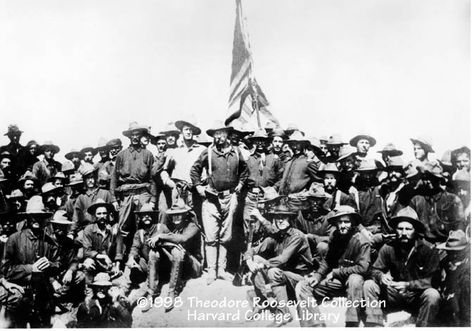
In Cuba, the Rough Riders suffer their first casualties at Las Guasimas.  They then advance to the San Juan Heights where the famous charge takes place.  It is just prior to the charge that O'Neill accepts Nash as a worthwhile soldier.  After the battle, Roosevelt requests Stephen Crane (author of the Red Badge of Courage and in Cuba as a correspondent) to take a picture of them.


There follows the return of some of the survivors to their homes and families.  And then, the story returns to the 'present' where Nash stands at the gravesites of some of his fellow Rough Riders and tells them the news of the day and that he has done well.

Berenger is generally very good as Theodore Roosevelt.  There is a clutziness about him, but that is surprisingly accurate.  Though a proponent of the strenuous life and the most famous outdoorsman president, he could seem a bit goofy.  He does not have the look or manner of the classic tough guy hero.  John Milius, who had already made a movie about Roosevelt (The Wind and the Lion, 1975), clearly knows TR.  At times, Roosevelt speaks French and German, demonstrates a knowledge of ornithology, declares his love a books (he was a voracious reader), could be abrupt in manner, and a man of action.  His dashing off to charge the next hill nearly alone is true to history.  He was once described as 'pure act.'

The Henry Nash of the miniseries is not the Henry Nash of history.  Rather than a stagecoach robber, the real Nash was a schoolteacher.  He and O'Neill were friends and political allies in Arizona.  After returning from Cuba, Nash traveled to the Philippines, where he died in 1902.  Considering how good much of the history was for the rest of the show, one wonders why a fictionalized Nash was inserted.  The fictionalized Nash provides an arc for the bad soldier who eventually sees the light.  Meh.  It should have been a truly fictional character, not using the name of a known Rough Rider.

Sam Elliot, who is the third major character of the miniseries, is terrific.  The Western hard-as-nails sheriff fits him perfectly.  Bucky O'Neill died just as shown and had claimed that there wasn't a Spanish bullet that could kill him.

Gary Busey was too young and too tall to play General Joe Wheeler.  Wheeler had been a Confederate General during the Civil War, was only 5'4" and had a full beard.  Busey is 6' and sported only a mustache.
 (bearded man is Wheeler, Roosevelt on the right, and Leonard Wood between them).
Though he didn't look like Fighting Joe, he was quite entertaining in the role.  His mixing up Yankees and Spaniards throughout the battle was good humor.

Brian Keith, who plays President McKinley, had portrayed Roosevelt in The Wind and the Lion.  This was his last movie role, and the movie is dedicated to him.

Overall, a very entertaining miniseries.  Recommended, especially in concert with Roosevelt's account of the Rough Riders.

The Rough Riders

While Theodore Roosevelt was working as the Assistant Secretary of the Navy, the USS Maine exploded in Havana.  War with Spain followed shortly.  Determined to see combat, Roosevelt immediately set about creating a volunteer force.  Speed was vital if he was to be present when the fighting started.  First, he needed a regimental commander with proven experience and respect.  He chose Leonard Wood, an active military man and Medal of Honor winner.  The 1st United States Volunteer Cavalry was recruited and reported to San Antonio for training.  A motley band, there were cowboys, Native Americans, hunters, miners, Ivy Leaguers, and others.  Many of them were already expert marksmen and skilled horsemen, so much of the training could focus on drill, military etiquette, chain of command, and general discipline.

In May of 1898, the Rough Riders boarded trains for Tampa Bay.  Once there, they boarded the transport ship Yucatan in June, arriving on the coast of Cuba a couple of weeks later.  Though a cavalry regiment, they were not allowed to bring their horses.  Thus, they were cavalry serving as infantry.  Roosevelt details Las Guasimas, the first battle where the Rough Riders saw action.  Thanks to malaria, Colonel Wood was elevated to brigade commander and Roosevelt rose to command the regiment, now Roosevelt's Rough Riders.  There follows the charge up Kettle Hill and San Juan Hill, and finally the siege of Santiago.  By mid-August, the Rough Riders were quarantined on Long Island until malaria abated.

Roosevelt offers extensive praise to the men, often using superlatives.  It is very much an on the ground account, seldom offering details of the bigger picture.  This is the war as Roosevelt saw it, occasionally reinforced with notes on the wider war if necessary.  It is sometime repetitive, giving the impression that there was not a lot of editing before being sent to print.  He does spend several pages countering the writings of other authors, notably on the number of Spanish troops in the area and the details of the Battle of Las Guasimas.  There is also extensive discussion of the lack of transport, food, and medical care.  The American logistics were terrible.  Merely noting that a cavalry regiment was deployed without horses says a lot.  Furthermore, the Spanish had superior rifles and used smokeless gunpowder.  This allowed them to quickly target US artillery and disable it.  Lastly, Roosevelt offered high praise, even pinning the largest share of credit for victory, on Lt. Parker and his Gatling Guns.

Highly entertaining account of one facet of the Spanish-American War.  It is a wonder that in a war that lasted less than 4 months, a volunteer unit was recruited, equipped, trained, and sent into the field to participate side-by-side with regular troops.  Recommended. 

Wednesday, January 4, 2023

Republicans with a Spine?

Kevin McCarthy has now failed to secure the speakership after 6 votes.  It is time to step aside and let someone else be speaker.  Of course, he's not going to do that.  He may yet arrange for Democrat votes to push him over the needed votes.  Imagine what sort of concessions that will require.  If he was truly interested in the good of the party, he would negotiate for another role and give up the speakership.  Really, the last Congress already settled the budget until September and the divided government means that anything the Republican House does will just be canceled by the Democrat Senate.  If ever there was a time for this sort of intraparty fight, now is it.  Once it's resolved, they won't get anything done anyway.  It's gridlock until January 2025, at minimum.

The great thing about the handful who have taken the fight this far is that they have been shown to possess something very rare among elected Republicans: a spine.  Yes, if McCarthy is finally elected, which he probably will be, he is going to be vindictive to these insurgents.  They know that, and still they protest.  Now, if only the rest of the Republicans could muster such sangfroid.

Tuesday, January 3, 2023

McCarthy Unqualified

The newly elected members of the House of Representatives met today to elect a Speaker.  The expectation was that Kevin McCarthy, the House Minority Leader, would be elected Speaker.  On the first vote - the one that has determined the Speaker for the past century, McCarthy failed to win a majority; he needed 218 votes but received 203.  In fact, the plurality of votes (212) went to a Democrat.  On the second ballot, McCarthy again failed to win the majority.  On the third ballot, McCarthy's vote total dropped to 202.

The Freedom Caucus telegraphed this move, allowing McCarthy the opportunity to politic in advance of the vote.  Either he failed to politic - which demonstrates that he is unqualified - or he failed to win the votes to avoid this embarrassment - which also demonstrates that he is unqualified.

Prior to the second vote, Matt Gaetz called upon the Republicans to vote for Jim Jordan.  On the first ballot, the votes for speaker were divided among 1 Democrat and 6 Republicans.  On the 2nd and 3rd ballots, the votes were divided among 1 Democrat (212), Kevin McCarthy (203/202), and Jim Jordan (20/19).  Unable to elect a Speaker, the House adjourned until tomorrow.

How will this impasse be overcome?  McCarthy could request votes from Democrats to make up his deficit, but that will involve some serious concessions that would destroy his speakership from the start.  He could offer concessions to the Freedom Caucus - which has a much stronger position that it had yesterday - to win enough votes.  However, that again leaves him as a weak Speaker.  He could step aside.  Even if he does this, Jordan will not be elected Speaker.  Jordan has shown hostility to the uniparty that has driven the debt to astronomical levels, ignored the open border, and shoveled billions of dollars to Ukraine.

Fresh of their 'victory' in the 2022 election, the Republican Party is imploding before it can even exercise power.  Time for popcorn!

Sunday, January 1, 2023

Our Army at Monterey

Following his account of Our Army on the Rio Grande, Thomas Bangs Thorpe wrote the further exploits of the Army of Occupation as it marched inland and captured the Mexican city of Monterrey.  In the wake of his victories at Palo Alto and Resaca de la Palma, Taylor's army greatly expanded as volunteer brigades arrived.  His forces moved upriver to secure Reynosa, Camargo, and Mier.  He then marched toward Monterrey, capturing towns enroute, notably Ceralvo.  On September 19, 1846, his vanguard arrived on the outskirts of Monterrey and discovered that the city was prepared for a siege.  Taylor obliged them.

General William Worth took a division of troops and looped west to capture the road to Saltillo and cutoff any support.  Additionally, he was ordered to capture the fortifications on the side of the city, notably the Bishop's Palace.  Meanwhile, General Twiggs' division was ordered to take the fortifications on the east of the city.  While Twiggs' forces were mauled by the interlocking batteries of multiple forts on the east, Worth secured his objectives with comparative ease.  For three days, the battle raged as the Americans pressed toward the main plaza from both directions.  General Ampudia, who had taken command after General Arista's back-to-back losses at the Rio Grande, saw that the city was lost.  On September 24th, he requested parley and, once there was a ceasefire, used Taylor's reluctance to resume combat to secure additional concessions.  Rather than surrender his army, he managed to march it out of the city with arms.

Though informative and containing first-hand accounts of all the American commanders of the action, it is far less engaging than the previous book.  It is a dry recitation of the action, almost completely one-sided as there is little from the Mexican forces.  There is a lot of repetition.  Thorpe offered a chapter on the negotiations for the surrender - which included the terms - and then the details of the surrender show up again later as a document.  This goes for officer deaths too.  During his account of the battle, he will mention how this officer was killed.  Later, in the obituary section, he details that officer's life and how he died.  Later, in the accounts of the various commanding officer, that death is again detailed.  Enough already.

As he had already provided a look at culture, architecture, fashion, cuisine, etc. in his previous book, he barely touches on these here.  Likewise, his travelogue account of Matamoros is not duplicated for Monterrey.  This is much more of a campaign account, lacking the breadth of the previous book.  Worthwhile to the student, but dreary otherwise.  Like Our Army of the Rio Grande, this book is long out of copyright and available for download here.

Blake's 7 (series 3)

The battle between the Federation and the alien fleet from the Andromeda galaxy has been won but the Liberator is in dire straits.  The life support fails and the crew abandons ship.  Avon (Paul Darrow) finds himself on a Medieval planet where the natives have a prophecy of invaders falling from the sky who must be killed.  Luckily, Avon is rescued by Dayna (Josette Simon), the daughter of a one-time rebel from Earth who is hiding on this planet.  Vila (Michael Keating) is on a different planet where the primitive people fear and avoid the 'high techs.'  When Vila is captured by a high-tech hunter, he is baffled by their fear.  For a while, at least.  Cally (Jan Chappell) was picked up by a neutral hospital ship.  News is that Jenna was injured but has survived.  Blake is missing.  In the meantime, Liberator has been self-repairing and, per instructions, seeks out the crew to teleport them aboard now that life support is restored.  Avon arrives with Dayna to find that a contingent of Federation troops have boarded, led by a snooty fellow named Del Tarrant (Steven Pacey).

The war cost the Federation 80% of its fleet and has left it crippled.  With Blake absent, the crew of the Liberator is free to wander the stars in an epidsodic fashion.  However, as the series progresses, it becomes clear that Servalan (Jacqueline Pearce) is doing a surprisingly good job of reconstructing the Federation.  Perhaps they should resume the fight against the Federation.

The absence of Blake nixes a lot of the purpose of the crew.  Initially, the story is survival in the wake of the war.  Then there are the random encounters of flying through space.  A few episodes that explore the past of this character or that character.  Finally, the show moves back toward the weekly showdown with Servalan and the Federation.  As such, it is a hodgepodge of a series.

Tarrant and Dayna are poor substitutes for Blake and Jenna.  Tarrant is so over-inflated with ego that it's a wonder he doesn't float to the ceiling.  He is meant to replace Jenna as pilot and Blake as idealist.  Despite being shown up on several occasions, he develops no humility.  He acts without thought, a reversal of the cautious and analytical Avon.  Avon's clashes with Tarrant are a pale reflection of those with Blake.  Worse still, Avon virtually cedes command of the Liberator to this blowhard.  It's almost like the scripts were written with Blake still present and Tarrant just got the lines with a little tweaking.  Weak.  As for Dayna, she is introduced as a weapons' specialist and master combatant.  These skills come and go depending on the needs of the script.  Her desire to kill Servalan, who murdered her father in the series opener, is easily restrained despite numerous opportunities to exact revenge.  I guess she isn't that eager to avenge her father.

Of note, the series proposes that the whole of the Milky Way galaxy has been mostly explored and colonized.  The Liberator crisscrosses the galaxy regularly.  However, this doesn't mesh well with how the technology is explained.  How fast is "Standard by Twelve?"  How is it that Avon, Vila, and Cally abandoned Liberator in the series premier from the same spot but landed on vastly different planets in different star systems?

The series ends with news that Blake died in the aftermath of the war, the destruction of the Liberator, and the apparent death of Servalan.  In fact, this was meant to end the series, but it came back for a fourth series.  In that case, here's another cliffhanger.