Showing posts with label Tom Berenger. Show all posts

Sunday, January 15, 2023

Rough Riders (1997)

It is 1920 and Henry Nash (Brad Johnson) limps into his attic to examine some of his old Spanish War memorabilia.  As he looks at a picture of the Rough Riders in Cuba, he declares how he misses them.  The story now switches to 1898 and the declaration of war between the United States and Spain.  Theodore Roosevelt (Tom Berenger) meets with Col. Leonard Wood (Dale Dye) to discuss a volunteer regiment.  Meanwhile, Henry Nash robs a stagecoach in Arizona.  He and his accomplice flee from a posse.  In an effort to escape, they join the volunteers for the war at a train station; they hope the train will leave before the posse arrives.  Nope.  Sheriff Bucky O'Neill (Sam Elliot) arrives.  It turns out they are not a posse, but a bunch of volunteers.  Nonetheless, O'Neill stares knowingly at Nash.

In San Antonio, the 1st United States Volunteer Cavalry begins training.  Among the recruits are western cowboys, lawmen, Native Americans, Ivy League collegians, etc.  It is an eclectic collection of men.  Of particular note, almost every named member is based on a real person.  Having just read Roosevelt's account, it was entertaining to see so many of those he named appear in the movie.  Though Nash wants to leave, he is convinced to stay.  This does not please O'Neill, who views him - correctly - as an unreliable soldier.  After a montage of training in terrain that is clearly not San Antonio, the regiment sets out for Florida.  In Florida, the Rough Riders finagle their way onto a transport to Cuba.

In Cuba, the Rough Riders suffer their first casualties at Las Guasimas.  They then advance to the San Juan Heights where the famous charge takes place.  It is just prior to the charge that O'Neill accepts Nash as a worthwhile soldier.  After the battle, Roosevelt requests Stephen Crane (author of the Red Badge of Courage and in Cuba as a correspondent) to take a picture of them.
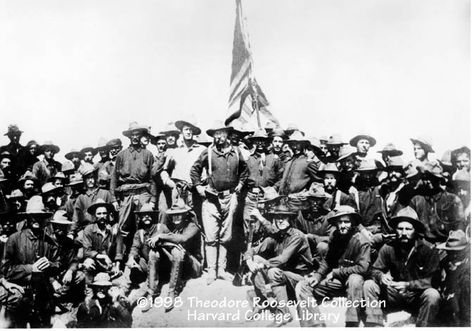

There follows the return of some of the survivors to their homes and families.  And then, the story returns to the 'present' where Nash stands at the gravesites of some of his fellow Rough Riders and tells them the news of the day and that he has done well.

Berenger is generally very good as Theodore Roosevelt.  There is a clutziness about him, but that is surprisingly accurate.  Though a proponent of the strenuous life and the most famous outdoorsman president, he could seem a bit goofy.  He does not have the look or manner of the classic tough guy hero.  John Milius, who had already made a movie about Roosevelt (The Wind and the Lion, 1975), clearly knows TR.  At times, Roosevelt speaks French and German, demonstrates a knowledge of ornithology, declares his love a books (he was a voracious reader), could be abrupt in manner, and a man of action.  His dashing off to charge the next hill nearly alone is true to history.  He was once described as 'pure act.'

The Henry Nash of the miniseries is not the Henry Nash of history.  Rather than a stagecoach robber, the real Nash was a schoolteacher.  He and O'Neill were friends and political allies in Arizona.  After returning from Cuba, Nash traveled to the Philippines, where he died in 1902.  Considering how good much of the history was for the rest of the show, one wonders why a fictionalized Nash was inserted.  The fictionalized Nash provides an arc for the bad soldier who eventually sees the light.  Meh.  It should have been a truly fictional character, not using the name of a known Rough Rider.

Sam Elliot, who is the third major character of the miniseries, is terrific.  The Western hard-as-nails sheriff fits him perfectly.  Bucky O'Neill died just as shown and had claimed that there wasn't a Spanish bullet that could kill him.

Gary Busey was too young and too tall to play General Joe Wheeler.  Wheeler had been a Confederate General during the Civil War, was only 5'4" and had a full beard.  Busey is 6' and sported only a mustache.
 (bearded man is Wheeler, Roosevelt on the right, and Leonard Wood between them).
Though he didn't look like Fighting Joe, he was quite entertaining in the role.  His mixing up Yankees and Spaniards throughout the battle was good humor.

Brian Keith, who plays President McKinley, had portrayed Roosevelt in The Wind and the Lion.  This was his last movie role, and the movie is dedicated to him.

Overall, a very entertaining miniseries.  Recommended, especially in concert with Roosevelt's account of the Rough Riders.

Sunday, December 25, 2022

One Man's Hero (1999)

On a US Army base somewhere near the Mexican border, Sgt. John Riley (Tom Berenger) visits a handful of men who will be whipped later for unnamed offenses.  They are all Catholics and mostly Irish.  Leaving them, he meets with the company captain and requests a pass to attend mass; Riley is also Irish and Catholic.  The captain is quite abusive toward the Catholics, viewing them as loyal to Rome rather than the US flag.  He sees them as traitors to England and wonders what Riley has in common with them.

"One man's hero is another man's traitor I reckon, sir," he replies.

Riley gets his pass and goes to mass.  He discovers quite a few soldiers - none of them with passes - are also attending the mass.  Part way through, the padre must leave.  The padre arrives at the US Army base to help the condemned men to pray.  Moments later, Riley and the other soldiers from the mass arrive and 'rescue' the men from their whipping.  Soon, they are in Mexico, where they are attacked by Cortina, a Mexican bandit and freedom fighter.  Riley meets Marta (Daniela Romo), a Mestizo woman, falls in love. The US deserters are housed by Cortina until the Mexican Army arrives.  Both Cortina and Riley are drafted into the Mexican Army to fight the gringos.  The Saint Patrick Battalion is formed with Major Riley in command.  They fight valiantly at Monterrey, but the US Army carries the city.  They fight again at Buena Vista (this battle is given only a vague montage that does not include General Santa Anna), before having to retreat.  They suffer ignominious defeat at Churubusco, seeing all the men either killed or captured, including Riley.  As Riley deserted before war was declared, he 'only' suffers 50 lashes and branding.  Many of the other San Patricios are hanged.  Riley returns to Cortina's mountain camp to resume his relationship with Marta.

The movie paints a picture of John Riley that does not match history.  First, he was a private, not a sergeant who was on the fast-track to the officer corps.  He had joined the US Army in 1843 and was still a private in 1846.  He did not desert as some noble effort to rescue men from a whipping, but simply swam the Rio Grande shortly after the US Army arrived across from Matamoros.  Speaking of that, the opening scene is ludicrous.  The army was camped at the Rio Grande and were mostly in tents.  Upon leaving the camp - which was near the nascent Fort Texas - they would have been met by Mexican cavalry.  The meeting with Cortina (Joaquim de Almeida) in mountains (?!) was nonsense.  Then there is the crazy idea that he was going to go back, as he was 'only AWOL, not a deserter.'  He entirely overlooked his role in assisting others to desert, during which arms were raised against the US Army. Though he was an officer of the San Patricio Battalion, he was not its commander; that was Colonel Francisco Moreno, who does not appear.  The entire side story of Riley's involvement with Cortina was pure fiction.  Also, John Riley was only 30 years old, whereas Tom Berenger was 50; perhaps that is why he was promoted to Sergeant for the script.

On other points, the story is closer to history.  The San Patricio Battalion did participate in battles of Monterrey, Buena Vista, and Churubusco.  For time and the sake of the fictional side story, the battle of Cerro Gordo was eliminated.  The battalion suffered a heavy blow at Churubusco, but was still active during the defense of Mexico City.  The captured San Patricios were indeed hanged for desertion.  This was notable as they should have faced a firing squad.

Though it was a small role, James Gammon was terrific as General Zachary Taylor.  He had the look of Old Rough and Ready and rode Old Whitey, a white horse.  Should have shaved off the mustache, but he was otherwise terrific.  Where Berenger was too old to play Riley, Patrick Bergin was too young to play General Winfield Scott.  His General Scott plays the Fuss and Feathers sobriquet as though it was the only feature of Scott.  In addition to being a brilliant general, Scott was a skilled diplomat.  The fate of the San Patricios is pinned on Scott like a scarlet letter in this telling, whereas it was only on account of Scott that Riley wasn't also hanged.  One odd thing was that none of the San Patricios, other than Riley, were historical.  A list of officers and men is available, but the makers chose not to include them.  Likewise, Captain Caine (Stephen Tobolowsky) and Lt. Colonel Benton Lacey (Mark Moses) are fictional.  Lt. Col. McIntosh commanded the 5th Infantry at the time Riley deserted.  The script has created fictional US Army officers whose sole purpose is to create sympathy for Riley; Gaine to justify desertion and Lacey to argue that Riley is a good and noble man.

The sets are disappointing.  The city of Monterrey is obviously a hastily built stage in the Mexican desert.  The battles are small scale.  It appeared that Cortina's cavalry command at the battle of Monterrey was just a couple of dozen men.  The San Patricio Battalion looks to be a score of men who operate 4 cannons.

Mediocre.  Skip.