Tuesday, February 28, 2017

Trump of the Union

President Trump addressed both houses of Congress, several members of the Supreme Court, and assorted others.  In his speech, he outlined the goals for his presidency.  Some of his goals, I liked.  Repeal the Affordable Care Act, allow health insurance to be sold across state lines, enforce the immigration laws, put the interests of American citizens before those of non-Americans, reduce the administrative state by repealing two regulations for every new one added, tax reform, and sundry other items.  He also offered some things I don't like.  An infrastructure plan bigger than Obama's stimulus from 2009, replacing the Affordable Care Act with some Republican version of government overreach, protectionism, and so forth.  On the one hand, we need to get government out of the way so the people can innovate and on the other hand we need the government to solve your problems.

Trump's speech sought to engage the heart rather than the mind.  He would offer a rationale for his policy preference and then trigger the emotions with an appropriate guest.  The multiple guests who provided concrete evidence for his claims was effective for stirring the emotions he sought.  It is far easier to groan and shake one's head about criminal illegal immigrants when an actual victim of such is not present.  At times, it felt more like a speech a Democrat would give.  It was funny to see Bernie Sanders clap when Trump argued that it should be difficult for companies to leave the United States.  However, like Obama with Bush, Trump blamed his predecessor for whatever ails the country.  Sigh.
 
It was a better speech than his Inaugural Address.  Though he had the digs against Obama, he repeatedly called for unity and offered a number of issues that the Democrats could support.  Though the speech likely reads as well or better than most such speeches, Trump does not have the oratorical talents of President Obama.  Just listening to the tone and rhythm, Obama is like music and Trump is like construction foreman trying to talk over the jackhammer in the background.
 
The Democratic rebuttal was weak.  Governor Beshear rebutted a speech that wasn't given.  As a stand-alone speech, it works okay but it addressed the Democrats impression of Trump rather than the just presented policy prescriptions.  There were a couple lines where, if this had been a debate, the moderator would have said, "he addressed that point.  Weren't you listening?"  Of course, I'm not a fan of the rebuttals, regardless of who is president.  Maybe if the Libertarian Party got to do the rebuttal...
 
All in all, Trump gave a good speech that will benefit him in the near term.  Those who watched will long remember the emotions that were evoked while completely forgetting the content.  That is probably the point.

Monday, February 27, 2017

Insiders vs. Outsiders

George W. Bush spent the entirely of the Obama Administration in silence.  He didn't speak out when President Obama unraveled Iraq and unleashed the disaster that followed.  He didn't speak when Obama led us into Libya, from behind.  He had no public comments about IRS targeting or the executive rewriting legislation without including the legislative branch.  He didn't feel the need to defend his record when Obama or his surrogates blamed virtually every problem on Bush.  No, he was quite comfortable to retire from the national stage and let President Obama have his turn.

Today, President Bush decided it was time to speak.  He offered a not-so-oblique criticism of President Trump and his treatment of the media.  Interesting.  He hadn't felt compelled to comment on Obama wiretapping the Associated Press or naming James Rosen as an unindicted co-conspirator so he could really spy on him.  No problem with Obama constantly denouncing Fox News.  Nope, nothing to say then.  Huh.

What could explain this change?  George W. Bush is an insider.  Like President Obama, he went to Harvard.  Like President Clinton, Hillary Clinton, and John Kerry, he attended Yale.  He is a member of the elite, a member of a dynastic family that goes back his grandfather, Senator Prescott Bush.  Heck, his great, great grandfather graduated from Yale in 1844!  Though they may not have titles like Baron, Earl, and Duke, we have an aristocracy in the United States and they are extremely unhappy that some peasant who went to Fordham in the Bronx is president!  A mere businessman lording over the anointed?  The horror!
 
Trump is a modern day Andrew Jackson.  Jackson had a mini-rebellion against the establishment, expanding the franchise and getting far too friendly with the common folk.  Like Trump, Jackson was hardheaded and not prone to eloquence.  Where John Quincy Adams and Henry Clay - who were rivals in the 1824 election - joined forces to deny Jackson the Presidency, Republican and Democrat elites are determined to protect the prerogatives that have taken more than a century to build.
 
This is not a left vs. right conflict but an insider vs. outsider one.

Master of Branding

There is a new survey that shows CNN has plummeted in perception compared to its cable competitors, Fox News and MSNBC.  Is this downward trend because of Trump's labeling CNN as fake news?  He recently altered that to 'very fake news.'  Trump seems to have a gift for pinning his opponents - and he has openly called the media in general and CNN in particular opponents - with harmful branding.  It struck me as childish during the primaries when he would use these demeaning nicknames for his rivals: Little Marco, Lyin' Ted, Low Energy Jeb, Crazy Bernie, Crooked Hillary.  It's like schoolyard name calling but the results speak for themselves.  Trump is playing a perception game and through these gimmicky nicknames, he creates a perception.  'Very fake news' looks to be a sad excuse for branding and yet it appears to have worked.
 
A good brand will get confirmed, even if it doesn't apply well.  If Trump could point to just a couple of instances - even if they were aberrations from the norm - that confirmed his branding, it will stick like glue.  Of course, Trump isn't the only one who knows how to brand.  There is a reason so many think he is a fascist, because Democrats are old pros at branding Republicans.  However, I would have to say Trump is better.  Democrats always use the same batch of brands (e.g. racist, fascist, homophobe, sexist, Nazi) while Trump is comparatively subtle and clever (e.g. Low Energy Jeb).
 
With Trump as the current owner of Teddy Roosevelt's bully pulpit, one must be cautious in drawing the ire of one so skilled at branding and shameless in doing so.  For the moment, it is fun to see the over-inflated egos of the Washington elites popped but where might it lead after that?

To the Moon!

In 1927, Charles Lindbergh flew the Spirit of St. Louis from New York to Paris, the first solo non-stop transatlantic flight.  It took him 33 and a half hours to fly the 3,600 miles.  Fifty years later, the Concorde was making the flight same flight in 3.5 hours.

In 1968, Apollo 8 became the first manned spacecraft to leave low earth orbit and orbit the moon.  Interestingly, Lindbergh was present at the launch to wish them well.  The mission was an epic achievement that was eclipsed only a few months later when Neil Armstrong set foot on the moon in July 1969.  The last time a manned spacecraft circled the moon was in 1972.

SpaceX proposes to send two civilians around the moon next year, repeating the historic Apollo 8 mission nearly 50 years after it was first accomplished.  Will the Dragon space capsule be as far advanced from the Apollo 8 command module as the Concorde was to the Spirit of St. Louis?  Will Frank Borman, Jim Lovell, or Bill Anders - all still living and well into their 80s - be present for a repeat of their mission?  I hope so.

The Elite Academy Awards

A recent article claimed that the movies that win are no longer popular with audiences.  It was mentioned that Rogue One earned more than $500 million at the box office and was essentially unnoticed whereas Moonlight, which earned $20 million was up for multiple awards.  It was an interesting point so I did some research.

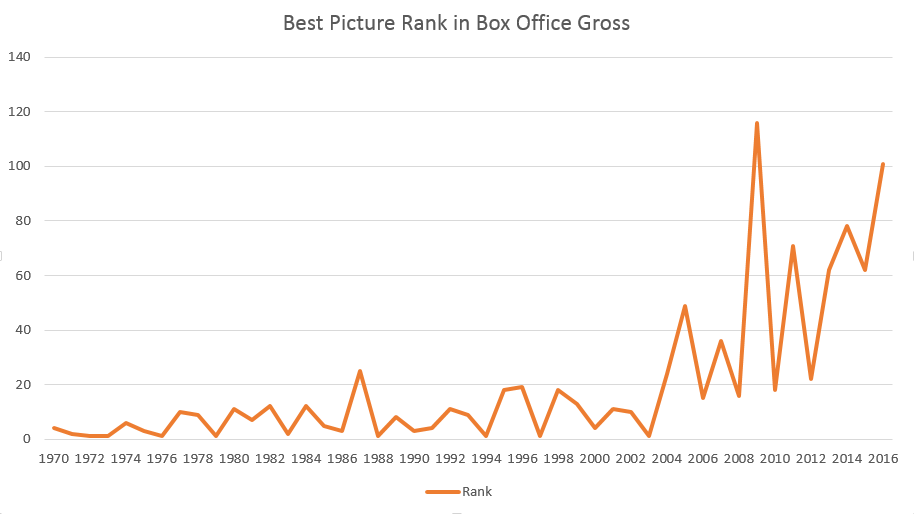
Since 2010, the average Best Picture winner is the 59th highest grossing movie of the year.  The King's Speech was the 18th highest grossing film in 2010, topping the group.  Moonlight was the 101st highest grossing film in 2016.

From 2000 to 2009, the average Best Picture winner was the 28th highest grossing movie.  Lord of the Rings: Return of the King was the number one earner in 2003 while The Hurt Locker was #116 on the other extreme.

From 1990 to 1999, the Best Picture winner was the 10th highest grossing movie.  Forrest Gump (1994) and Titanic (1997) were both the top grossing movies of their year.  The English Patient was the weakest of the bunch at 19th in 1996.  Note that 18th was the highest rated movie in the current decade whereas 19 was the lowest in the 90s.  Hmm.

From 1980 to 1989, the winner averaged 9th highest gross.  Rain Main was #1 in 1988.  The Last Emperor was the lowest of the bunch at 25th in 1987.

From 1970 to 1979, the winner averaged 4th!  Kramer vs. Kramer, Rocky, The Sting, and The Godfather were all the top earners for the year they won.  Annie Hall was the weakest of the bunch at 10th.
 
Given that, is it any wonder that the ratings for the Academy Awards are down?  This graph is revealing:
 

The change is accelerating.  By 2030, no one outside the academy will have seen the Best Picture of the Year.

Saturday, February 25, 2017

Thinking BIG

Michael Munger, PhD Economist of Duke, was on EconTalk to propose a transition toward a Basic Income Guarantee (BIG).  Basically, the government provides a minimum income to all citizens.  He argues in favor for two reasons.  First, some people - through no fault of their own - will find themselves displaced.  For example, if self-driving cars take over, lots of truck drives and cabbies will find themselves without jobs.  Second, we already have a very inefficient BIG program that is distributed through multiple programs (e.g. CHIP, TANF, SNAP, WIC, Public Housing, etc.) which could be streamlined into a BIG.  I am unclear on whether Social Security and Medicare are likewise to be streamlined; I would think so.  Of course, many of the programs that would be abolished are means tested while the BIG would be universal.  Munger proposed a $15,000 a year BIG which would be conferred along the lines of the Earned Income Tax Credit.

This idea has been around for a while but this is the most in depth discussion I have encountered so far.  Generally, it looks like a bad idea.  A guaranteed income will be a disincentive to work.  People on the dole tend to have lower self-esteem and little purpose in their lives.  However, Munger thinks jobs might become scarce with the rise of Artificial Intelligence (AI), thus his example of self-driving cars.  It is likely that many would work 'off the books' to get extra income while still benefiting from the full BIG.  That currently happens, so maybe that isn't really a mark against it.  It reminds me of the Roman Bread and Circuses, where Rome provided food and entertainment to the masses.  As Rome's affluence grew, the civic-mindedness of the people at the empire's core rotted away.  The Emperors kept them fat and happy, which also made them useless.

However, the AI argument does sound convincing.  Of course, we have had such waves of creative destruction before.  Think of the thousands of telephone operators who lost there jobs thanks to technology.  No mass unemployment.  What of the farmers who were replaced by tractors?  What of the 'computers' like those in Hidden Figures who were replaced by calculators and computers?  There has long been the belief that technology will eventually make humans obsolete but it has repeatedly not come to pass.  Is AI the silver bullet that will really dramatically reduce the need for human labor?  If so, the BIG may become a necessity.

Here is the transcript and there is a link to the podcast available too.

Method to his Madness?

Here is what may be a very insightful article by Charles Krauthammer.  Donald Trump has been doing deals for decades.  He has spent years piecing together complicated land deals, navigating building codes and gambling licensing in multiple states, interacting with fellow billionaires, lobbying government, and playing golf with the powerful and influential.  He wrote The Art of the Deal!  Moreover, he somehow convinced enough people to vote for him to win the presidency.  At this point, it would be foolish to think all of this was just happenstance, that he didn't have some terrific skills at doing deals, be they for the purpose of building a casino in Atlantic City or becoming President of the United States.  Krauthammer is onto something here, especially with the good cop-bad cop analogy.  Trump can play the mad king (hopefully he isn't really a mad king) and send out his sober minions to assure everyone that they have things under control but it would be helpful if some changes were made to assuage him.
 
Has Trump simply imported his business tactics to politics?  When Tiger Woods brought true athleticism to golf, he changed the game.  Has Trump done that for politics?  Yes, I think he has.  Of course, like Tiger, he would need to be successful for his innovations to really spread and change the political landscape.